Co-Axial vs. Lever Escapement: Has Omega's Bet Actually Paid Off?
In the long history of mechanical watchmaking, genuinely new ideas are vanishingly rare. The lever escapement, invented by Thomas Mudge around 1754 and refined by Abraham-Louis Breguet, has dominated portable timekeeping for more than two centuries. Every Rolex, every Patek Philippe, every A. Lange & Sohne relies on some variant of this single mechanism. So when a lone English watchmaker announced in 1974 that he had created something better, the Swiss industry did what institutions do when confronted with disruptive ideas: it ignored him. The watchmaker was George Daniels. The idea was the co-axial escapement. And the question of whether it has actually improved mechanical watchmaking -- or merely provided Omega with a marketing differentiator -- remains one of the most interesting technical debates in modern horology.
How the Swiss Lever Escapement Works
To understand what Daniels changed, one must first understand what he was trying to fix. The Swiss lever escapement is an elegant solution to a fundamental problem: how to release energy from a wound mainspring in precisely metered intervals. It accomplishes this through the interaction of three components: the escape wheel, the pallet fork, and the balance wheel with its hairspring.
The escape wheel, driven by the gear train, has specially shaped teeth that engage with two jeweled surfaces -- the entry and exit pallets -- mounted on the pallet fork. As the balance wheel oscillates, it drives the pallet fork back and forth, unlocking one escape wheel tooth per swing. This cycle occurs at a rate determined by the balance wheel's frequency -- typically 28,800 vibrations per hour (4 Hz) in modern calibers, though frequencies range from 21,600 vph (3 Hz) to 36,000 vph (5 Hz) in high-frequency calibers like the Zenith El Primero.
The critical feature is impulse -- the moment when the escape wheel pushes against the pallet jewel, transferring energy to maintain oscillation. In the Swiss lever design, this impulse is delivered through a sliding action: the escape wheel tooth slides along the jewel's surface. This sliding contact requires lubrication, and it is here that the lever escapement's Achilles' heel is exposed.
The Lubrication Problem
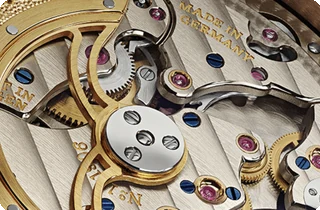
The lubricants used on escapement surfaces -- specialized synthetic oils like Moebius 9415 -- must maintain viscosity under extreme conditions: contact pressures measured in gigapascals, temperature fluctuations, and millions of cycles per year. Over time, even the finest lubricants degrade. They oxidize, migrate, or thicken, increasing friction and reducing energy transfer efficiency. As lubricant deteriorates, balance wheel amplitude decreases, positional variation increases, and accuracy suffers. The traditional service interval of three to five years is driven largely by the anticipated lifespan of escapement lubrication.
This is the problem George Daniels set out to solve.
George Daniels and the Co-Axial Invention
George Daniels, widely regarded as the greatest watchmaker of the twentieth century, spent nearly two decades developing the co-axial escapement. His insight was deceptively simple: if the primary source of wear and lubricant degradation in the escapement was the sliding friction of impulse delivery, why not redesign the geometry so that impulse is delivered through a radial action -- a brief pushing contact rather than a prolonged sliding one?
The co-axial escapement achieves this through a fundamentally different architecture. Instead of a single escape wheel, it employs two coaxially mounted wheels (hence the name) operating at different levels. The impulse is delivered to the balance wheel through a combination of these two wheels, and the geometry is arranged so that the contact between escape wheel teeth and pallet jewels is predominantly tangential rather than sliding. Daniels estimated that this reduced friction at the impulse surfaces by approximately 60 to 75 percent compared to the Swiss lever design.
The Theoretical Advantages
The reduced friction promised interconnected benefits: less lubricant degradation meant longer service intervals; more efficient energy transfer meant better amplitude stability and chronometric performance; and reduced component wear meant an extended functional lifespan. Daniels spent two decades refining the co-axial and attempting to persuade Swiss manufacturers to adopt it. His efforts were met with indifference and, in some cases, hostility. Rolex reportedly examined the design and declined. Patek Philippe showed interest but ultimately passed.
I was treated as if I were some lunatic who had wandered in off the street, rather than a Fellow of the Royal Society presenting a genuine advancement in escapement technology. -- George Daniels, recalling his reception in Switzerland
Omega's Adoption: From Caliber 2500 to Master Chronometer
It was Nicolas Hayek Sr., the visionary co-founder of the Swatch Group, who finally gave the co-axial escapement its commercial opportunity. Hayek recognized both the technical merit and the marketing potential: Omega would be the only brand in the world with a fundamentally new escapement technology. In 1999, Omega introduced the Caliber 2500, the first mass-produced movement to incorporate the co-axial escapement, debuting in a limited edition of the Omega De Ville.
The Troubled Early Years
The Caliber 2500 was not a triumph of execution. Based on an ETA 2892-A2 architecture modified to accept the co-axial module, early versions (2500, 2500B, 2500C) suffered from reliability issues. Reports of the escapement "tripping" -- where the balance wheel fails to properly unlock the escape wheels, causing the watch to gain dramatically or stop -- were not uncommon. The root cause was manufacturing tolerance: the co-axial's geometry demands tighter dimensional precision than the lever escapement, and Omega's initial production processes were not yet calibrated for these demands.
The 8xxx and 9xxx Revolution
The real vindication of the co-axial concept came not with the Caliber 2500 but with the development of Omega's in-house 8xxx and 9xxx caliber families, beginning with the Caliber 8500 in 2007. These movements were designed from the ground up around the co-axial escapement rather than adapted from existing architectures. The result was a fundamentally more robust and refined implementation.
The 8500 featured a free-sprung balance wheel with a silicon hairspring (eliminating the vulnerability to magnetic fields that affects traditional Nivarox hairsprings), a Co-Axial escapement with optimized geometry, two barrels for a 60-hour power reserve, and an architecture that allowed Omega to achieve chronometer certification rates above 99 percent at the production level.
But Omega did not stop there. In 2015, in partnership with the Swiss Federal Institute of Metrology (METAS), Omega introduced the Master Chronometer certification -- a testing protocol that goes significantly beyond the traditional COSC chronometer standard. Where COSC tests movements in five positions and at three temperatures over fifteen days, the METAS protocol tests the cased watch (not just the movement) across a broader range of conditions, including exposure to a 15,000-gauss magnetic field.
The Data
This is where the conversation shifts from theory and marketing to measurable outcomes. METAS certification requires accuracy within 0 to +5 seconds per day -- a tighter tolerance than COSC's -4/+6 seconds per day. Omega reports that their Master Chronometer-certified movements typically achieve accuracy within 0 to +2 seconds per day in real-world wear, and independent testing by publications like Watchuseek and aBlogtoWatch has generally corroborated these claims.
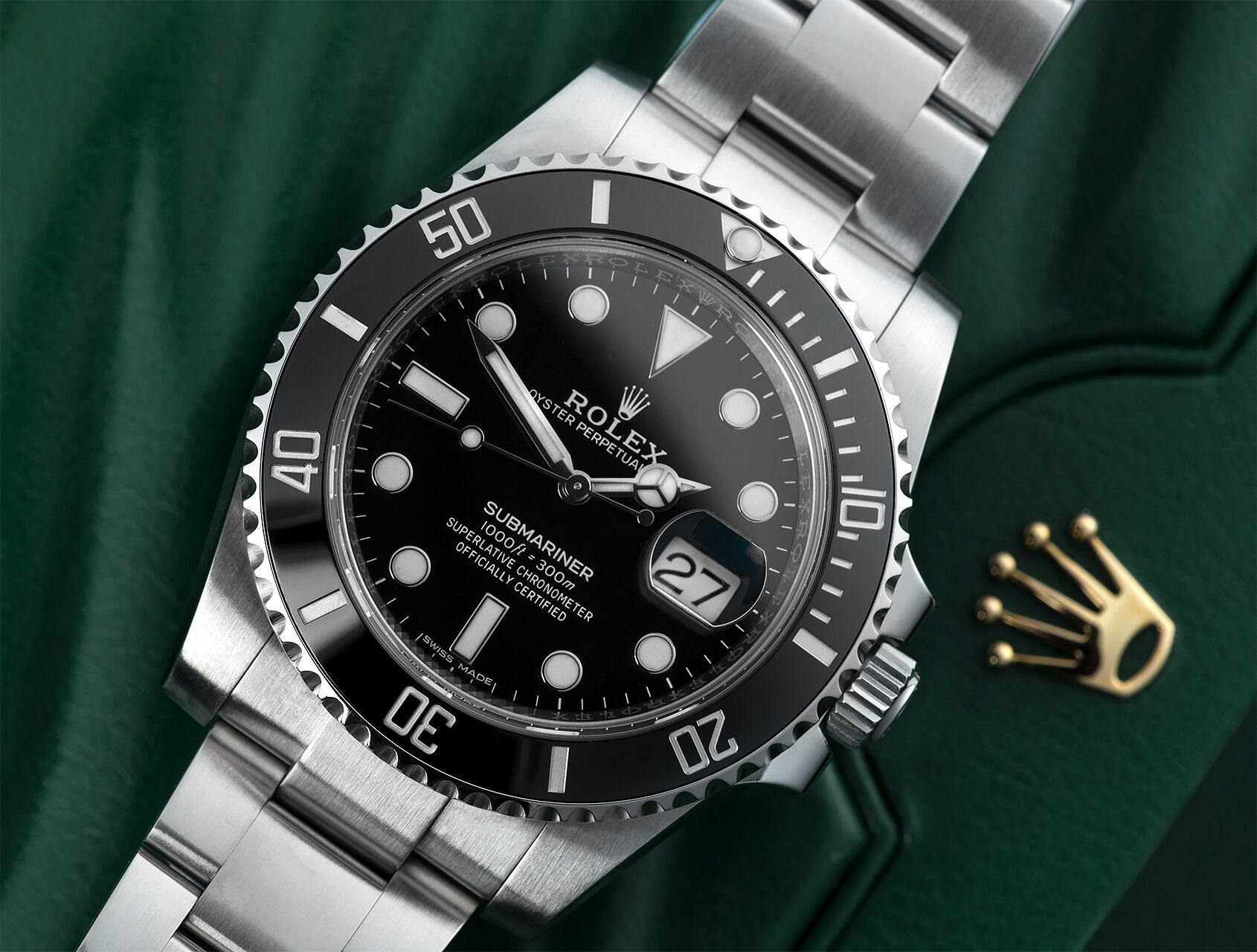
On service intervals, Omega officially recommends servicing their co-axial movements every eight years -- a significant extension from the three-to-five-year intervals recommended for most mechanical watches. This extended interval reflects confidence in the reduced lubricant degradation promised by the co-axial design. For context, Rolex, which has invested heavily in its own lubrication technology (including proprietary Chronergy escapement and Syloxi silicon hairspring), recommends a service interval of ten years for its current Caliber 32xx movements. The traditional industry standard remains three to five years.
It is worth noting, however, that Rolex achieves its extended service interval without abandoning the lever escapement, instead relying on advanced lubricants, improved surface finishes, and the reduced friction characteristics of their Chronergy design (which optimizes the geometry of the lever escapement rather than replacing it). This raises a legitimate question: has the co-axial escapement delivered a meaningful real-world advantage over a well-engineered modern lever escapement, or has lubricant technology advanced to the point where the lever's friction disadvantage has been substantially mitigated?
The Broader Implications
Why No One Else Adopted It
One of the most telling facts about the co-axial escapement is that, twenty-seven years after its commercial introduction, no other manufacturer has adopted it. This is not for lack of awareness. Every major Swiss manufacture has examined the technology. None has chosen to implement it.
The reasons are instructive. First, tighter manufacturing tolerances increase production costs, and for brands that have spent decades optimizing lever escapement production, retooling offers debatable incremental benefit. Second, the lever's serviceability is a practical advantage: any competent watchmaker can service one, while the co-axial requires specialized knowledge and Omega-sourced parts -- a meaningful drawback as watches age. Third, the co-axial has not demonstrated the transformative chronometric improvement its theory suggests. Grand Seiko's Hi-Beat calibers, Rolex's Superlative Chronometer movements, and Chopard's L.U.C calibers achieve comparable or better accuracy. The playing field has been substantially leveled by improvements in conventional technology.
What the Future Holds
The co-axial escapement's legacy may ultimately be measured not by the number of brands that adopted it, but by the competitive response it provoked. Rolex's Chronergy escapement, Zenith's Defy Lab oscillator, TAG Heuer's Isograph carbon hairspring, and the industry-wide adoption of silicon components can all be traced, at least in part, to the competitive pressure created by Omega's willingness to innovate at the escapement level. George Daniels may not have replaced the lever escapement, but he may have saved it -- by forcing the industry to dramatically improve it.
The Verdict
Has Omega's bet on the co-axial escapement paid off? The answer depends on how you define success.
As a marketing proposition, it has been extraordinarily effective. The co-axial escapement gives Omega a genuine technical story that differentiates it from every other brand in its price segment. In a market where brand narratives matter enormously, this is not a trivial advantage.
As a technical advancement, the picture is more nuanced. The early Caliber 2500 implementations were problematic, and the co-axial's advantages have been partially offset by improvements in conventional escapement technology. But the 8xxx and 9xxx caliber families, particularly in their Master Chronometer form, are genuinely excellent movements that deliver on the core promises of accuracy, magnetic resistance, and extended service intervals.
As a revolution in watchmaking, the co-axial escapement has fallen short of Daniels' dream. It has not replaced the lever escapement. It has not been adopted industry-wide. It remains, after nearly three decades, an Omega proprietary technology.
But perhaps that is not the right measure. In an industry where genuine mechanical innovation is extraordinarily rare -- where most "new" calibers are evolutionary refinements of existing architectures -- the co-axial escapement stands as one of the very few truly new ideas of the past century. George Daniels devoted his life to the belief that the escapement could be improved. Omega bet its technical identity on that belief. Whether or not the co-axial escapement is objectively "better" than the best modern lever escapements, it has enriched the landscape of mechanical watchmaking. And for collectors who value innovation alongside tradition, that enrichment has a worth that transcends service intervals and accuracy benchmarks.
The Provenary Editorial Team
Expert perspectives on the art and science of watch collecting, market analysis, and the stories behind the timepieces that define horological history.