
The Collector's Dilemma: When to Sell, When to Hold, and How Data Should Drive the Decision
Every serious collector eventually confronts the same question: should I sell this watch? The impulse arrives in many guises -- a new reference appears that demands capital, a valuation seems unsustainably high, or the simple recognition that a piece no longer earns its place on the wrist. Yet the decision to sell or hold a significant timepiece is one of the most consequential a collector can make, and it is remarkable how often it is driven by emotion, hearsay, or gut feeling rather than data. In a market where a single reference can swing 40 percent in value within eighteen months, as several have in recent years, disciplined analysis is not a luxury. It is a necessity.
Three Case Studies in Price Dynamics
To ground this discussion in reality rather than abstraction, let us examine three of the most closely tracked references in the modern market: the Rolex Submariner Date 116610LN, the Patek Philippe Nautilus 5711/1A, and the Audemars Piguet Royal Oak 15500ST. Together, they represent the three dominant pillars of the luxury sports watch segment and offer instructive lessons about market cycles, liquidity, and the psychology of collectors.
Rolex Submariner 116610LN: The Benchmark
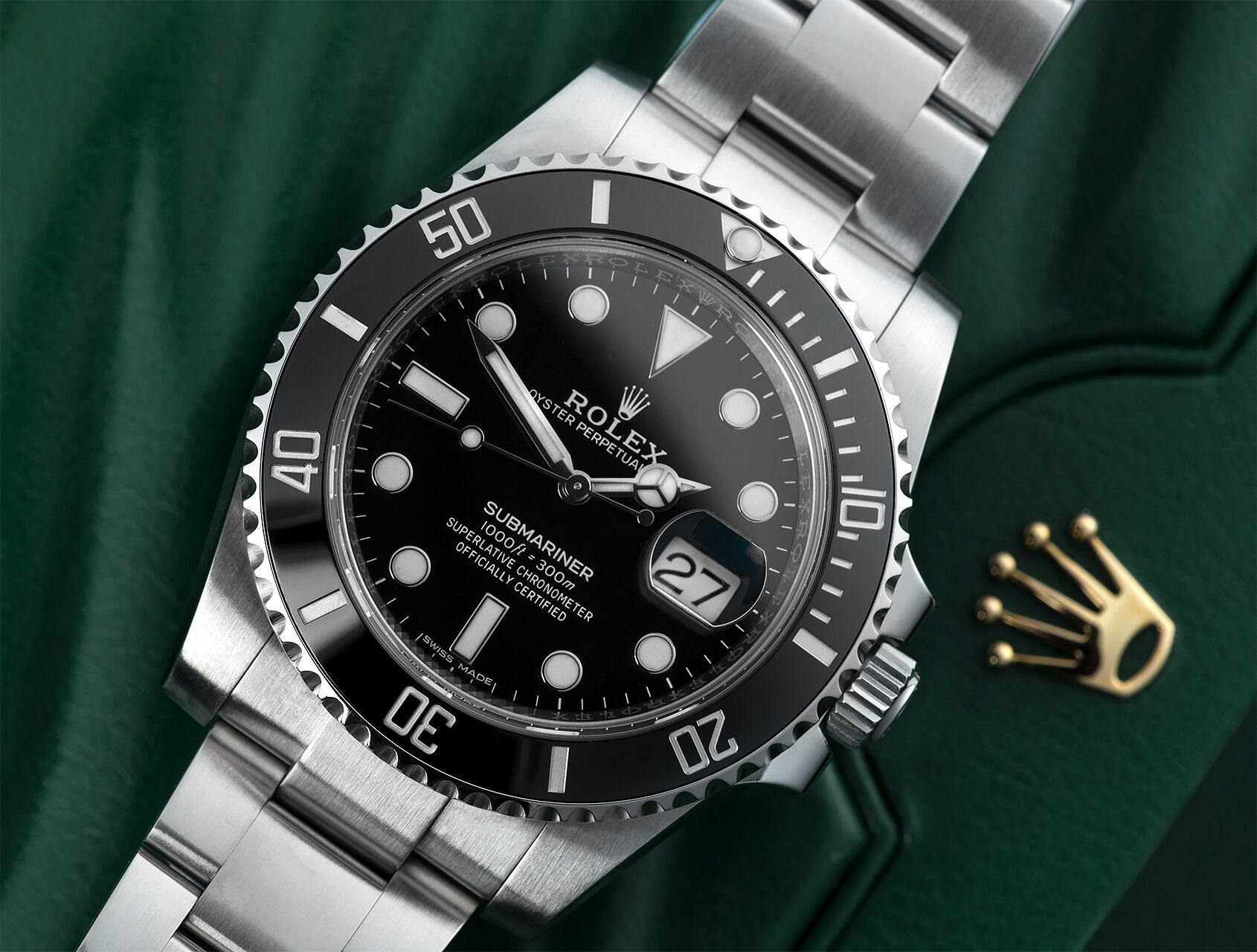
The Submariner Date 116610LN, produced from 2010 until its discontinuation in 2020 (replaced by the 41mm 126610LN), is as close to a benchmark asset as the watch market offers. Its price trajectory tells the story of the entire luxury watch boom and its aftermath.
In early 2019, a 116610LN with box and papers traded for approximately $8,500 to $9,500 -- near its retail price of $8,550. By mid-2021, pandemic supply constraints and the model's discontinuation had pushed prices to $13,000 to $14,000. Then came the speculative mania: fueled by stimulus liquidity, crypto wealth, and social media hype, prices spiked to $16,000 to $18,000 by March 2022. Market data from WatchCharts and Chrono24 confirms this trajectory was broadly representative.
The correction was swift. The 116610LN declined to approximately $12,000 by year-end 2022, bottoming near $10,500 in late 2023. Since then, it has stabilized between $10,500 and $12,000 -- still above retail, but a far cry from the peak.
Patek Philippe Nautilus 5711/1A: The Bubble and Its Lessons
If the Submariner 116610LN is the market's benchmark, the Patek Philippe Nautilus 5711/1A-010 (blue dial) is its cautionary tale. The 5711 was discontinued in January 2021, an announcement that ignited one of the most spectacular price bubbles in collecting history.
The 5711/1A already traded at a premium to its $30,000 retail, fetching $60,000 to $70,000 on the secondary market. But the discontinuation announcement created a parabolic move: by March 2022, a 5711/1A-010 was trading for $180,000 to $200,000 -- more than six times retail. The correction has been severe. As of early 2026, the reference has found support around $85,000 to $100,000 -- a decline exceeding 50 percent from peak.
The lessons are clear. Discontinuation announcements are not automatic buy signals when the scarcity premium is already priced in. The magnitude of correction was proportional to the bubble's inflation. And the collectors who profited were overwhelmingly those who acquired before the market recognized the opportunity -- patient holders, not momentum chasers.
Audemars Piguet Royal Oak 15500ST: The Stabilizer
The Audemars Piguet Royal Oak 15500ST presents a more instructive pattern. Neither discontinued nor replaced, its trajectory reflects organic demand rather than scarcity-driven speculation. Retailing at approximately $24,000 for the blue dial, it peaked at $52,000 to $58,000 in 2022 before correcting to $35,000 to $40,000 by mid-2023, where it has stabilized through early 2026 per WatchCharts data. The 50 to 65 percent premium over retail appears sustainable -- a model for what healthy appreciation looks like.
Depreciation Curves: What the Data Tells Us
Beyond individual case studies, broader market data reveals systematic patterns that informed collectors can exploit.
Sports watches vs. dress watches. The depreciation curves for these two categories are strikingly different. A Rolex Datejust or Omega De Ville typically experiences 15 to 25 percent depreciation in the first year of ownership, stabilizing after three to five years at roughly 60 to 70 percent of retail for popular references. Sports watches from the major three -- Rolex, Patek Philippe, and Audemars Piguet -- frequently appreciate above retail immediately or experience minimal depreciation, provided the reference is desirable. Dress watches from brands below the top tier (Jaeger-LeCoultre, Blancpain, Breguet) can depreciate 30 to 40 percent within two years -- a reality that new buyers should factor into their acquisition calculus.
The five-year inflection. Market data consistently shows an inflection point around the five-year mark for many references. Watches that have depreciated during their first five years often stabilize, and previously "common" references begin to develop collector interest as the first-generation owners move on. The Omega Speedmaster Professional "Sapphire Sandwich" (reference 311.30.42.30.01.006), for example, traded below retail for several years before beginning a steady appreciation that has continued through 2026.
The ten-year and vintage inflection. A second, more dramatic inflection often occurs around the ten-year mark, particularly for discontinued references. At this point, supply in the secondary market begins to thin as long-term holders absorb available inventory. The transition from "pre-owned" to "collectible" begins, and pricing power shifts from buyers to sellers. References that cross the twenty-year threshold increasingly move into the vintage category, where condition, provenance, and completeness (box, papers, service history) command exponential premiums.
Liquidity: The Forgotten Variable
Valuation is only half the equation. A watch is worth its market price only if you can actually sell it at that price, and liquidity varies dramatically across brands, references, and market conditions.
Rolex enjoys the deepest liquidity: a Submariner or Daytona can sell within days via Chrono24 or Bob's Watches, with bid-ask spreads of 5 to 10 percent. This liquidity is itself a form of value. Patek Philippe and Audemars Piguet are highly liquid for sports references (Nautilus, Royal Oak) but significantly less so for dress watches and grand complications. Independent brands -- F.P. Journe, MB&F, De Bethune -- present the thinnest markets: finding the right buyer at the right price can take months, and quick liquidation typically requires accepting a meaningful discount.
Portfolio Thinking for Serious Collections
The most sophisticated collectors increasingly approach their collections with the same rigor that governs investment portfolios. This does not mean reducing watches to mere financial instruments -- the emotional and aesthetic dimensions of collecting are irreducible and essential. But it does mean applying frameworks from portfolio theory to optimize outcomes.
Diversification
A collection concentrated in one brand or category is exposed to concentration risk -- the all-Nautilus collector in early 2022 learned this painfully. Diversification across brands, categories (sports, dress, complications), and eras (modern, vintage) reduces volatility and increases the probability of capturing value creation wherever it occurs.
Correlation With Other Assets
Watch prices have historically shown low correlation with traditional asset classes -- equities, bonds, and real estate -- making them a genuinely useful diversification tool within a broader wealth portfolio. However, the 2021-2022 bubble revealed that in periods of extreme liquidity (or extreme liquidity withdrawal), watch prices can become temporarily correlated with risk assets, particularly cryptocurrency and speculative equities. Collectors should be aware that their watch collection, while generally uncorrelated, is not immune to macroeconomic forces.
Insurance Valuation vs. Market Value
A critical but often overlooked distinction. Insurance valuations are typically set at replacement value -- the cost to acquire an equivalent piece at retail or near-retail. Market value, which fluctuates with supply and demand, may be significantly higher or lower than insurance value at any given time. During the 2022 peak, many collectors found that their collections' market values substantially exceeded their insurance coverage, leaving them underinsured. Regular reappraisal -- ideally annually for significant collections -- is essential. Provenary's valuation tracking tools are designed precisely for this purpose, providing real-time market data alongside historical insurance valuations to ensure collectors maintain appropriate coverage.
Tax Implications: The Uncomfortable Truth
In the United States, watches held for more than one year are subject to the collectibles capital gains rate of 28 percent -- higher than the 15 to 20 percent standard rate for stocks. A $50,000 profit means up to $14,000 in federal tax alone. In the United Kingdom, capital gains tax on collectibles applies at 10 to 24 percent for disposals exceeding 6,000 GBP. European jurisdictions vary widely.
The practical implication: when selling at a modest profit, the after-tax, after-transaction-cost return (dealer commissions run 10 to 20 percent for consignment) can be negligible. This is a powerful argument for holding unless capital is needed for a clearly superior opportunity.
The best time to sell is when the decision is driven by data and strategy, not by emotion or urgency. The worst time to sell is when everyone else is selling too.
A Framework for the Decision
Drawing together these threads, we can propose a structured framework for the sell-or-hold decision.
Sell when: a reference has experienced parabolic appreciation detached from fundamentals; when proceeds would fund a clearly superior acquisition; when data signals secular demand decline (increasing days-on-market, widening bid-ask spreads); or when portfolio rebalancing requires reducing concentration.
Hold when: the reference is in a stable trend supported by organic demand; when emotional value exceeds financial value; when tax and transaction costs would consume a disproportionate share of the gain; or when the piece approaches a vintage inflection point.
Never sell to chase a trend already priced in. By the time a reference appears on social media as a "must-buy," the smart money has already acquired.
The Role of Data in a Human Endeavor
Watch collecting is, at its heart, a deeply personal pursuit. The watches we choose, the stories they carry, and the emotions they evoke are not reducible to spreadsheets and price charts. But the financial dimension of collecting is real, and ignoring it does not make it disappear. The collector who understands depreciation curves, liquidity profiles, tax implications, and market cycles is not less passionate than the collector who ignores these factors -- they are simply better equipped to sustain and grow a collection over decades.
Platforms like Provenary exist to bridge this gap -- to provide the data infrastructure that allows collectors to make informed decisions while preserving the joy and humanity that make collecting worthwhile. Track your valuations. Document your provenance. Understand your market. And when the moment comes to sell, let the data guide the decision and the heart confirm it.
The Provenary Editorial Team
Expert perspectives on the art and science of watch collecting, market analysis, and the stories behind the timepieces that define horological history.