
The Lost Golden Age of American Watchmaking: Hamilton, Elgin, and What Killed an Industry
In the summer of 1969, while Neil Armstrong wore his Swiss-made Omega Speedmaster on the surface of the Moon, the factories that had once made America the greatest watchmaking nation on earth were already dying. In Lancaster, Pennsylvania, the Hamilton Watch Company -- which had built marine chronometers accurate enough to navigate warships across the Pacific -- was in the process of moving its production to Switzerland. In Elgin, Illinois, the vast redbrick complex of the Elgin National Watch Company, which at its peak had employed over 4,000 workers and produced more than half of all watches sold in the United States, was preparing for its final closure. In Waltham, Massachusetts, the birthplace of the American watch industry itself, the last precision movement had already been assembled, the machinery sold off, the skilled craftsmen scattered to other trades.
The collapse of American watchmaking is one of the great untold industrial tragedies of the twentieth century. At its zenith, the American watch industry represented the most advanced manufacturing system on the planet -- a system that had, in many respects, invented the very concept of precision mass production. The principles developed in the watch factories of New England and the Midwest would go on to shape the manufacture of everything from sewing machines to automobiles to aircraft engines. And yet the industry that pioneered these methods could not, in the end, save itself. The story of how America built, perfected, and ultimately lost its watchmaking heritage is not merely a tale of corporate failure. It is a parable about innovation, complacency, and the merciless logic of technological disruption.
The Waltham Revolution
The American watch industry begins, in every meaningful sense, with a bankruptcy. In 1850, a Boston watchmaker named Aaron Dennison conceived an audacious idea: to manufacture watches using interchangeable, machine-made parts, rather than the hand-fitted components that had been the standard of watchmaking since the sixteenth century. The concept was not entirely new -- Eli Whitney had famously championed interchangeable parts in musket manufacturing decades earlier, and the principle was central to what historians would later call the "American System of Manufactures." But no one had attempted to apply it to anything as intricate as a watch movement, where tolerances were measured in thousandths of an inch and a single poorly fitted component could render the entire mechanism useless.
Dennison's first attempt, the Warren Manufacturing Company, failed. His second, reorganized as the Waltham Improvement Company and later as the American Watch Company, nearly failed as well. The early years were consumed by the staggering technical challenge of building machines precise enough to produce watch components to the required tolerances. The jewel holes had to be perfectly round and perfectly positioned. The gear teeth had to mesh with absolute consistency. The balance staff -- the axle on which the balance wheel oscillates -- had to be turned to a diameter measured in hundredths of a millimeter.
But by 1860, the Waltham factory had solved the essential problems. Its watches, while not yet equal to the finest Swiss hand-made movements, were consistent, reliable, and -- critically -- affordable. A Waltham Model 1857 could be produced in a fraction of the time and at a fraction of the cost of a comparable European watch. The implications were revolutionary. For the first time in history, a precision timekeeper was within reach of the ordinary working man. The democratization of accurate timekeeping, which would reshape everything from railroad schedules to factory discipline to the very concept of punctuality, had begun in a brick factory on the banks of the Charles River.
The Elgin Epoch
The success of Waltham inspired imitators, and the most formidable of them arose in a quiet town forty miles northwest of Chicago. The National Watch Company -- later renamed the Elgin National Watch Company -- was incorporated in 1864 by a group of investors led by Benjamin W. Raymond, a former mayor of Chicago. They recruited Waltham-trained watchmakers, purchased state-of-the-art machinery, and built a factory complex that would eventually sprawl across thirty-five acres on the banks of the Fox River.
Elgin's timing was impeccable. The company's first movements were completed in 1867, just as the post-Civil War economic expansion was creating an enormous new market for reliable, affordable timepieces. The railroads, expanding relentlessly westward, needed accurate watches by the thousands for their conductors, engineers, and station agents. Farmers, merchants, and factory workers -- newly prosperous and newly conscious of the importance of precise timekeeping in an industrializing economy -- provided a seemingly insatiable domestic demand.
By the 1880s, Elgin was producing over 2,000 watches per day and had become the largest watch manufacturer in the world by volume. The company's B.W. Raymond grade, named for its founding investor and produced in various iterations from 1867 through the 1950s, became one of the most respected American watch movements ever made. The finest B.W. Raymond movements -- 21-jewel, adjusted to five positions and temperature -- offered accuracy that rivaled the best Swiss chronometers at a price that Swiss manufacturers could not match.
The Railroad Grade Standard
No single factor shaped American watchmaking more profoundly than the railroad industry. In the early decades of American railroading, there was no standardized timekeeping system. Conductors and engineers used whatever watches they happened to own, set to whatever local time prevailed at their point of departure. The result was a system prone to catastrophic failure.
The disaster that finally forced reform occurred on April 19, 1891, near Kipton, Ohio, when two Lake Shore and Michigan Southern Railway trains collided head-on, killing nine people. The investigation revealed that the engineer of one train had been relying on a watch that had stopped for four minutes and then resumed running, leaving him unaware that he was behind schedule. The tragedy prompted Webb C. Ball, a Cleveland jeweler, to establish the first standardized timekeeping requirements for American railroads.
The resulting "railroad grade" standards, adopted by most major railroads by the mid-1890s, were extraordinarily demanding. A railroad-approved watch had to be open-faced (so that the crown was at the 12 o'clock position, allowing the time to be read consistently), with a minimum of 17 jewels, adjusted to at least five positions and temperature, and accurate to within 30 seconds per week. The dial had to have bold Arabic numerals and a separate seconds dial at 6 o'clock. The watch had to be inspected regularly by an authorized watch inspector, and any watch that failed to meet the accuracy standard was immediately removed from service.
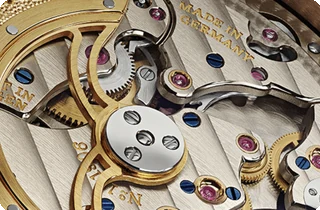
These standards created a captive market for the highest grades of American pocket watches, and the manufacturers responded with some of the finest movements ever produced on either side of the Atlantic. The Hamilton 992B, introduced in 1940, is widely regarded as the pinnacle of American railroad watchmaking -- a 21-jewel, lever-set movement with a motor barrel mainspring that delivered extraordinary timekeeping consistency. The Elgin B.W. Raymond and the Waltham Vanguard were its closest competitors, and all three were produced to standards that placed them among the most accurate series-produced mechanical timekeepers in the world.
The railroad grade market was enormously profitable and provided American manufacturers with a guaranteed domestic demand that insulated them from foreign competition. Swiss watchmakers, for all their prowess in haute horlogerie, could not easily replicate the specific configurations required by American railroad standards. This protected market would prove to be both a blessing and a curse: it sustained the industry through the first half of the twentieth century, but it also bred a complacency that left the manufacturers unprepared for the changes that would follow.
Hamilton and the Pinnacle of American Horology
Of the three great American watch companies, Hamilton occupied a unique position. Founded in 1892 in Lancaster, Pennsylvania -- absorbing the assets of several earlier failed ventures -- Hamilton positioned itself as the quality leader, producing movements that were consistently among the most finely finished and accurately regulated in the American industry. Where Waltham and Elgin competed aggressively on volume and price, Hamilton pursued a strategy closer to that of a Swiss manufacture, emphasizing craftsmanship, accuracy, and prestige.
The strategy paid dividends in the military arena. During the Second World War, Hamilton received one of the most critical and demanding contracts in the history of American manufacturing: the production of marine chronometers for the United States Navy. Marine chronometers -- highly accurate, temperature-compensated clocks used for celestial navigation -- had been the exclusive province of a handful of European makers, principally in England and Switzerland. With European sources cut off by the war and American naval forces engaged across two oceans, the Navy desperately needed a domestic supplier.
Hamilton rose to the challenge with remarkable speed and ingenuity. The company developed the Model 21 marine chronometer, a 14-ligne movement with a detent escapement and bimetallic balance, housed in a gimballed wooden box. Over the course of the war, Hamilton produced approximately 10,000 of these chronometers -- an extraordinary feat of precision manufacturing that would have been inconceivable to any European maker, accustomed to producing such instruments in small batches by hand. The Hamilton marine chronometers were accurate, reliable, and, most importantly, available in the quantities that a global naval war demanded. They are widely credited with contributing materially to the Allied victory in the Pacific, where accurate navigation was essential for the vast distances involved.
Hamilton's wartime production extended well beyond chronometers. The company manufactured millions of military watches, fuzes, and other precision instruments for the armed forces. The Hamilton military watches -- particularly the hacking-seconds models issued to soldiers and sailors -- introduced an entire generation of American men to the concept of the wristwatch as a serious, masculine instrument, much as the trench watches of the First World War had done for European men a generation earlier.
The Post-War Decline
The seeds of destruction were planted in the very moment of triumph. When the war ended in 1945, American watch manufacturers found themselves in a paradoxical position. Their factories were tooled for mass production on a scale that dwarfed anything in Switzerland. Their workforce was trained and experienced. Their brand reputations had never been higher. And yet the market they returned to was fundamentally different from the one they had left.
The railroad grade market, which had sustained the industry for half a century, was entering a slow but irreversible decline. Diesel locomotives were replacing steam engines, and the new locomotives came equipped with dashboard clocks. Improved signaling systems reduced the reliance on individual timekeeping. The rigorous inspection regimes that had required every railroad employee to carry a certified American pocket watch were gradually relaxed. The captive domestic market that had insulated American manufacturers from foreign competition was evaporating.
Simultaneously, the Swiss watch industry was embarking on an aggressive global expansion, fueled by a combination of lower labor costs, a weaker franc, and a marketing sophistication that American manufacturers could not match. Swiss brands like Omega, Longines, and Rolex had spent the war years building their reputations in the wristwatch market -- a market segment that American manufacturers had largely neglected in favor of their lucrative military and railroad contracts. When American consumers began demanding wristwatches in the booming post-war economy, they increasingly looked to Switzerland.
Hamilton, to its credit, attempted to adapt. The company introduced a series of innovative wristwatch designs in the 1950s, including the Ventura (1957), the world's first electric watch, designed by the industrial designer Richard Arbib in a dramatic asymmetric case that remains one of the most recognizable watch designs ever created. The Ventura was a genuine innovation -- it replaced the traditional mainspring with a battery-powered electromagnetic balance system -- and it was a commercial success. But it was not enough to offset the structural decline in Hamilton's core business.
Elgin fared worse. The company attempted to compete on price against an influx of cheap imports from Japan and Hong Kong, a strategy that eroded its brand positioning without addressing its fundamental cost disadvantage. By the late 1950s, Elgin was losing money on nearly every watch it sold. The company closed its Illinois factory in 1964, the centennial year of its founding, and thereafter sourced its movements from Switzerland and Japan. The Elgin name lingered on dials for another decade, but the company that had once been the world's largest watch manufacturer was effectively dead.
Waltham's decline was equally dispiriting. The original American Watch Company had ceased domestic production in 1957, and the Waltham name was subsequently licensed to various entities that used it on imported watches of steadily diminishing quality. The grand factory complex in Waltham, Massachusetts -- where the American watch industry had been born a century earlier -- was sold and eventually converted to commercial and residential use.
The Quartz Apocalypse
If the post-war period was a slow decline, the quartz revolution was a sudden death. In December 1969, the Japanese firm Seiko introduced the Astron, the world's first commercially available quartz wristwatch. The Astron used an electrically vibrated quartz crystal oscillator to regulate its timekeeping, achieving an accuracy of plus or minus five seconds per month -- a performance that no mechanical watch, regardless of price, could approach. The retail price was 450,000 yen, roughly equivalent to a small car, but the technology was inherently inexpensive to manufacture, and prices fell rapidly.
By the mid-1970s, the quartz revolution had become a quartz apocalypse. The Swiss, Japanese, and American industries were all devastated, but the Americans -- already weakened by two decades of post-war decline -- were hit hardest. Hamilton sold its American operations to the Swatch Group in 1974 and relocated entirely to Switzerland, where it continues to operate today as a respected but mid-range Swiss brand. Elgin had already abandoned domestic manufacturing. Waltham survived only as a brand name on imported watches. By 1980, there was not a single company mass-producing mechanical watch movements in the United States.
The extinction was nearly total. An industry that had employed tens of thousands of skilled workers, that had pioneered the principles of precision mass production, that had produced timepieces used to navigate warships and coordinate railroad networks across a continent, simply ceased to exist within the span of a single generation. The factories were shuttered, the machinery was scrapped or sold, and the institutional knowledge accumulated over more than a century was dispersed and, in many cases, lost entirely.
What Remains, and What Is Being Rebuilt
The story of American watchmaking does not end, however, with the closures and liquidations of the 1970s. In recent decades, a small but passionate group of independent watchmakers has begun the painstaking work of rebuilding an American horological tradition.
RGM Watch Company, founded by Roland G. Murphy in Lancaster, Pennsylvania -- Hamilton's hometown -- in 1992, is the most prominent of these new independents. RGM produces hand-finished mechanical watches using movements that are assembled and regulated in Pennsylvania, some incorporating American-made components. The company's PS-801 series, featuring movements with traditional American-style finishing -- including damaskeening, the distinctive wavy pattern that characterized the best Waltham, Elgin, and Hamilton movements -- represents a conscious effort to reconnect with the aesthetic traditions of the golden age.
Kobold Watch Company, founded by Michael Kobold in Pittsburgh in 1998, has pursued a different path, focusing on rugged tool watches designed for extreme conditions. Kobold's approach echoes the functional, purpose-driven ethos of Hamilton's wartime production, and the company has cultivated relationships with military and exploration communities.
Weiss Watch Company, founded by Cameron Weiss in Los Angeles in 2013, represents perhaps the most ambitious attempt to revive American watchmaking. Weiss, a trained watchmaker who apprenticed at both Audemars Piguet and Vacheron Constantin in Switzerland, produces watches using movements assembled and regulated entirely in his Los Angeles workshop. The company's emphasis on American manufacturing -- including cases machined from American-sourced steel -- reflects a conviction that a genuine American watch industry can be rebuilt, one watch at a time.
These independents face formidable challenges. They lack the economies of scale that make Swiss and Japanese production efficient. They operate without the deep institutional knowledge that was lost when the old factories closed. They compete for attention in a market dominated by brands with centuries of heritage and billions in marketing budgets. And yet they persist, driven by a belief that the American watchmaking tradition deserves a future as well as a past.
Lessons From the Ruins
What can today's watch industry -- and today's collectors -- learn from the rise and fall of American watchmaking? Several lessons emerge with clarity.
First, no market position is permanent. Waltham and Elgin were, at various points, the largest and most successful watch manufacturers on earth. Their dominance seemed unassailable. Within a generation, they were gone. The Swiss industry, which survived the quartz crisis only through radical restructuring and a strategic pivot to luxury, would do well to remember this.
Second, innovation is necessary but not sufficient. Hamilton's Ventura was genuinely innovative. Elgin invested in electric and electronic movements. But these innovations were tactical responses to a strategic problem -- the fundamental shift in global manufacturing economics -- that no single product could address.
Third, and most relevant to collectors, the watches themselves endure. A Hamilton 992B railroad chronometer, properly maintained, will keep time as accurately today as it did in 1942. An Elgin B.W. Raymond from the 1920s remains a masterpiece of precision manufacturing. A Waltham Model 1892 is a window into the birth of the American System applied to its most demanding application. These watches are artifacts of an industrial civilization that no longer exists, and their value -- both historical and monetary -- reflects their irreplaceability.
For collectors, American vintage watches represent one of the most undervalued segments of the horological market. While a vintage Rolex or Patek Philippe commands prices that put them beyond the reach of most enthusiasts, exceptional examples of American railroad-grade watches can still be acquired for hundreds, not thousands, of dollars. The documentation challenge is significant -- many American watches have lost their original papers and service records over the decades -- but platforms like Provenary offer the possibility of building new provenance records that can accompany these historic timepieces into the future.
The golden age of American watchmaking is gone. The factories are silent, the machinery dismantled, the workers long since retired or passed on. But the watches survive. In collections, in estate sales, in the display cases of specialized dealers, and increasingly in the workshops of new American independents who are trying to reconnect a severed thread, the legacy of Waltham, Elgin, and Hamilton continues to tick. It is a quieter sound than it once was. But for those who listen carefully, it remains one of the most compelling stories in the history of horology.
The Provenary Editorial Team
Expert perspectives on the art and science of watch collecting, market analysis, and the stories behind the timepieces that define horological history.